
GOVERNANCE
Artificial Intelligence Technology Policy
Policy No. 02/26
Date Approved: February 18, 2026
Dates Amended:
Reporting Requirement: As set out in sections:
Legislative Authority: Community Safety and Policing Act, 2019 s. 38 and s. 40,
1. Policy Statement
The York Regional Police Service Board (the Board) is committed to advancing innovation and improving public safety by incorporating evidence-based best practices for the deployment of Artificial Intelligence (AI) technologies, while closely aligning with the principles of fairness, transparency, accountability, and privacy standards.
The purpose of the AI policy is to ensure the Board is constructively engaged in reviewing the deployment of new or enhanced technologies that use artificial intelligence, which are deemed to present a moderate to high risk of disproportionately impacting some members of the community. In deploying or enhancing artificial intelligence enabled technologies, the Board will prioritize the needs and well-being of those impacted individuals, while considering the broader institutional and public benefits of artificial intelligence. The Board is committed to assessing and mitigating potential risks to legal rights and on an ongoing basis following their launch. To promote accountability and transparency, the Board may, at its discretion, evaluate and perform audits or reviews, where appropriate, while continuing to safeguard privacy, public safety, and intellectual property rights.
The AI policy is essential to ensuring compliance with privacy rights, Ontario’s Human Rights Code, and the Canadian Charter of Rights and Freedoms. It mandates that the York Regional Police Service (Police Service), operate transparently and provide equitable service enhancement through the use of AI technologies, ensuring any adoption is open and inclusive. It also requires the Police Service to conduct meaningful stakeholder consultations to anticipate potential negative impacts on public welfare or service quality and to establish oversight and governance mechanisms that are proportionate to the level of risk and potential harm associated with the artificial intelligence system, ensuring accountability and continuous evidence-based evaluation throughout the AI life cycle.
2. Application
This policy applies to:
- The Chief of Police
- The Board in its civilian oversight capacity
- The Executive Director of the Board
3. Definitions
Artificial Intelligence (“AI”): AI is a technology that enables computers to perform tasks that typically require human intelligence. This includes using algorithms to automate processes, analyze data, recognize patterns, and support decision-making. Examples range from drone technology and crime hot-spot prediction to natural language processing models.
AI Lifecycle: AI lifecycle encompasses the following phases that are not necessarily sequential: planning and design; collecting and processing data; building and using the model; verifying and validating; deployment; and operating and monitoring.
AI Output: Is new content which is generated based on input data or user prompts. Any output generated by an AI tool, including analytics and reports, is considered to be a new information or data product.
AI Technology: Any and all training, self-improving, or machine learning software, algorithms, hardware or other AI tools or aids of any kind.
Bias: Is a systematic flaw in an AI system's output that is unfair or prejudicial. Bias can originate from flawed data or algorithms, leading to outputs that disadvantage individuals or groups based on protected grounds. Bias can originate from flawed data sets or algorithms, leading to outputs that disadvantage individuals or groups based on protected grounds.
Data: Refers to any information collected and stored through the deployment of AI technology and any information collected and stored that will be used by such AI technology
Operational: Means the conduct of policing functions, including administrative functions, crime prevention and detection, traffic control, crowd management, community policing, investigations, calls for service, writing reports, officers notes, operational documentation and the exercise of police powers.
Responsible Use: Means the use of an AI application that has been formally reviewed, approved, and licensed for use by the Police Service and is deployed in a manner that mitigates risks (including bias and privacy infringement).
Risk management: A systematic approach to setting the best course of action under uncertainty by identifying, assessing, understanding, acting on, monitoring, and communicating risk issues
4. Responsibilities
The Chief of Police shall establish the necessary procedures and processes defining the acceptable use and limitations on the deployment of AI Technology use by the Police Service.
4.1 Guiding Principles:
The Chief of Police shall ensure the following principles are adhered to when considering the adoption and use of AI technology:
- Transparency: In instances where the Police Service uses AI technology which have an impact on decisions that affect members of the public, they must be given notice of such uses, unless full transparency may unduly impact the efficacy of investigative techniques or operations. In such cases, the Chief of Police will endeavour to make publicly available as much information about the AI technology as practicable, to assure the public of the reliability of the AI technology and the justifiability of its use.
- Accountability: All use of AI technology must be transparent and subject to performance measurement against recognized industry standards, supported by a clear governance framework, that ensures those responsible remain accountable for the decisions they make, including those informed or influenced by AI technology or other algorithmic tools.
- Fairness: Use of AI technology must not result in the increase or perpetuation of bias in policing and should seek to reduce the existence of such biases. The application of AI technologies in the delivery of police services must foster fairness by:
- Ensuring equality and non-discrimination in AI operation;
- Protecting vulnerable groups from potential biases or adverse impacts;
- Promoting diversity and accessibility in AI development and use; and
- Enabling the review and correction of AI-supported decisions.
- Justifiability: The use of AI technology must be shown to further the purpose of law enforcement in a manner that outweighs identified risks.
- Legality: All technology used, and all use of technology, in the course of delivering police services, must comply with applicable law, including the Community Safety and Policing Act (and its regulations, and successor legislation), Ontario’s Human Rights Code, the Canadian Charter of Rights and Freedoms, and be compatible with applicable due process and accountability obligations.
- Public Engagement: Where appropriate, public engagement can be crucial in establishing that AI technologies are used responsibly and takes a measured approach to the risk, cost, and community impact in the use of AI technology.
- Privacy: Any use of AI technology must protect personal and sensitive information that is collected, and must be proportionate and reasonable, and minimize potential risks and negative impacts.
- Reliability: AI technology must demonstrate reliable and repeatable behaviour, producing AI outputs or recommendations that are consistent, while ensuring that any risks from inaccurate results are carefully assessed and avoided in contexts where factual accuracy or data integrity is essential.
4.2 Procurement and Approval
The Chief of Police Shall:
-
Ensure the appropriate industry standard risk assessment tools are incorporated into the review of AI technologies.
- Conduct a risk assessment of the AI technology, prior to the earlier of:
- Seeking funds for the new AI technology, including but not limited to applying for a grant, or accepting municipal, provincial or federal funds, or public or private in-kind or other donations;
- Acquiring the new AI technology, including acquiring such technology without the exchange of monies or other consideration;
- Entering into agreements to acquire, share, or otherwise use such AI technology;
- Not procure, utilize, or deploy a new AI technology deemed to have a real risk of significant harm to the community, compromise the legitimacy of the Board, or Police Service.
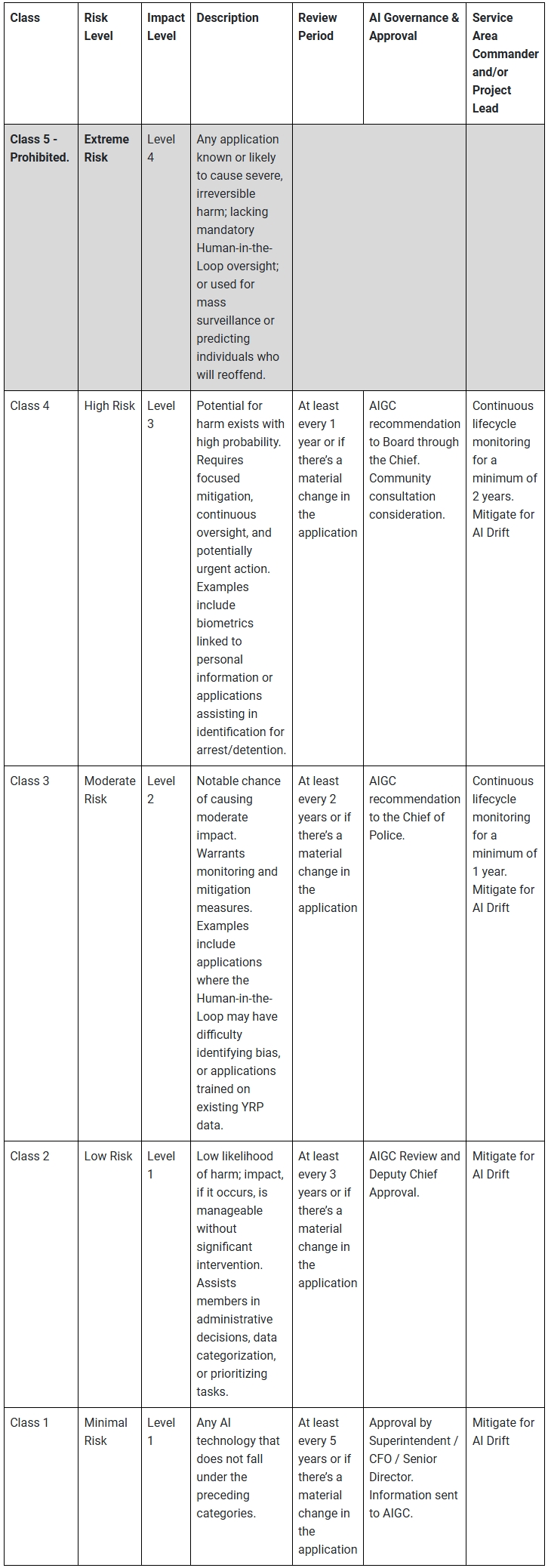
- When reporting to the Board and seeking approval for the procurement and deployment of AI technology with a risk classification of three (3) or four (4) the report will describe, at a minimum:
- The operational need(s) the AI technology will address, the intended use by the Police Service and how use of the AI technology will improve on current practices or operations;
- Identify the risk level assigned to the AI technology, the rationale for the risk level assigned, and the rationale for continuing with the procurement, use or deployment despite the associated risk;
- The findings of a Privacy Impact Assessment and any risk analyses carried out in accordance with section 4.2(a) above, including any analyses required by the Information and Privacy Commissioner of Ontario and the legislative authority for the collection of personal information;
- How the AI technology operates, the source of the training data, and evidence of the validity, accuracy and security of the AI technology under consideration, based on industry standards;
- An evaluation of the AI technology vendor, including its record with regard to data security, privacy and ethical practices;
- The estimated cost of acquiring and implementing the AI technology.
- Develop and implement a public engagement strategy for AI technology assigned class three (3) and four (4) risk, to transparently inform the public of the use of the AI technology that collects data about members of the public or assists users in identifying, categorizing, prioritizing or otherwise making decisions pertaining to members of the public, prior to its deployment.
- Once completed, the feedback received from consultations with relevant stakeholders and the general public will also be reported to the Board.
The Board Shall:
- Review the reports submitted in accordance with section 4.2(d) and may determine;
- If additional analysis is required prior to approval of the procurement, deployment or use of the new AI technology;
- That the Service may initiate the procurement, deployment or use of the AI technology, and identify any additional analysis, monitoring, auditing and reporting requirements beyond the ones required by this Policy that are to be imposed once use of the AI technology commences.
4.3 Deployment of AI Technology
The Chief of Police Shall:
- Ensure the training of users of any AI Technology must address effective, legal, and ethical uses. Any follow-up training must be delivered to update the knowledge and skills of users as the AI technologies evolves.
- Consult with the stakeholders and impacted communities to identify and address any concerns arising from the use of AI technologies which are categorized as class three (3) and four (4) respectively (as defined in the Attachment 1). The results of consultations will be reported to the Board, including any actions taken to mitigate the risks and the harms of the AI technologies.
- Actively address and mitigate biases caused by the use of AI technologies to prevent discrimination against any community and ensure equitable outcomes.
- Prohibit the use of any existing AI technology that poses a serious risk or is harmful to the community.
4.4 Data Privacy and Security
The Chief of Police Shall:
- Establish a privacy policy to include strict protocols for the collection, storage, access, and sharing of data to be used by or for AI technologies, adhering to privacy laws and regulations.
- Ensure there are security measures to safeguard sensitive and personal information against unauthorized access and data breaches that will be caused by the improper use of AI technologies or any external cyber threats.
5. Reporting and Transparency
Chief of Police shall:
- Develop performance indicators that align with industry standards which can be tracked by the Police Service, aimed at determining whether the AI technology is achieving its intended goal.
- Maintain and regularly update a registry of AI systems used by the Police Service. The registry shall contain the following information:
- Name and manufacturer/developer,
- Risk level associated with the AI technology,
- Purpose of the technology and its intended use by the Police Service.
- Following one year after the deployment for use of any AI technology identified in class four (4), or if there is a material change in the application, or as may be required by the Board, a public report shall be submitted to the Board that demonstrates compliance with this policy and an assessment of the achievements of the AI technologies according to the indicators required by section by 5(a) at the time the technologies were deployed.
- Following two years after the deployment for use of any AI technology identified in class three (3), or if there is a material change in the application, or as may be required by the Board, a public report shall be submitted to the Board that demonstrates compliance with this policy and an assessment of the achievements of the AI technologies according to the indicators required by section by 5(a) at the time the technologies were deployed.
- Present these reports to be considered by the Board in its regular public meetings, with the exception of any confidential information in the report in accordance with applicable law. In those instances, information will be provided to the Board separately, as a confidential attachment to the public report.
The Executive Director shall:
- Ensure the Board’s website allows the public to register and submit their concerns regarding the use of AI technologies that have been approved in accordance with this AI Policy.
- Ensure that receipt of all such submissions is acknowledged.
- In any year where the Board has received public submissions or a complaint about the use of any AI technology identified at class three (3) or four (4) respectively, the Executive Director and the Chief of Police shall jointly report to the Board with a summary of the concerns raised by a submission and the response provided.
6. Compliance and Review
The Board Shall:
- Review the AI Policy annually, reporting to the Board as needed where required updates are identified by staff review, to ensure that it successfully achieves its identified purpose.